
Denton County · Slabs on clay or sand
Slab Foundation Repair in Denton, TX
How deep the piers go depends on your band: deep clay to the west and east, sand over clay in the middle, rock close below in a few spots.
A slab foundation is a concrete floor poured right on the ground. When part of that ground shrinks, swells or washes out, the slab above it tips or bends. The house shows it: a crack running up from a door frame, a tile line that splits, a door that suddenly won't latch. Slab foundation repair in Denton, TX means finding out why that section moved, then carrying it on supports that reach steadier ground.
- Free inspection
- No obligation
- Town-by-town soil data
- Referral service, disclosed
- Call (940) 535-7201
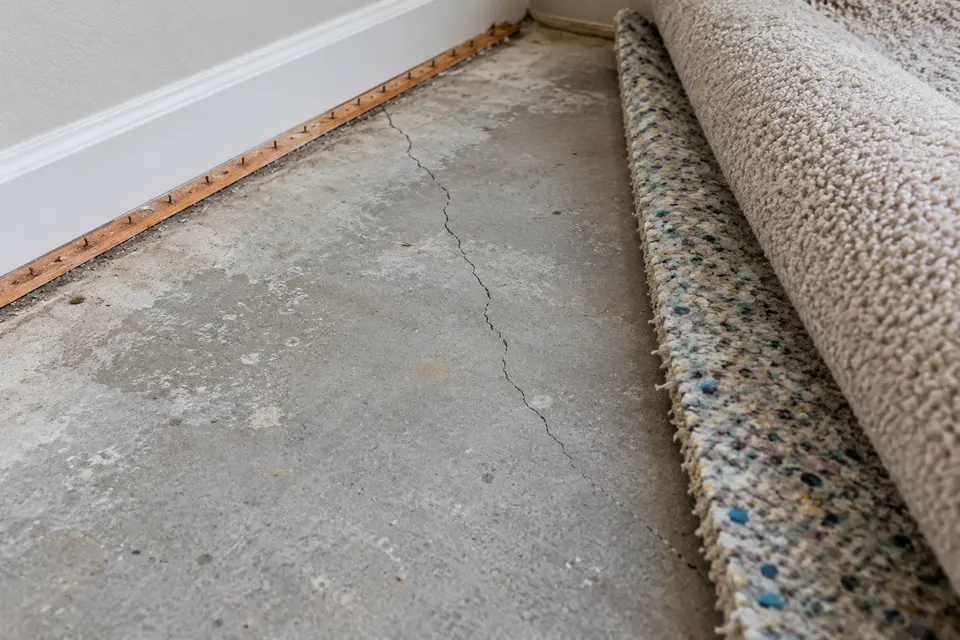
Where that steadier ground starts isn't the same across Denton County. On some lots it's below several feet of swelling clay. On a few, it's rock about a foot down. A free inspection measures your floors first, so the plan fits your house.
What have you seen?
When You Need Slab Foundation Repair
Spotting a crack is a reason to look closer, not proof you need piers. The Texas Section of the American Society of Civil Engineers lists the signs engineers look for when they judge a foundation. They include:
- Cracks outside in brick or siding, or inside in drywall
- Door and window frames racked out of square
- Walls separating from the ceiling or floor
- Floor coverings that crack or lift
- Joints that were tight when the house was built opening up
The same guidelines say that seeing some of these doesn't by itself mean the foundation is failing. What decides it is a floor survey, which measures how far each part of the slab sits above or below the rest. One repair company with a Lewisville office says 1 in 3 of the people it evaluates don't need any repair at all.
Is It a Slab Leak?
Water under a slab can look a lot like foundation trouble. In Denton, the city fixes leaks between the street and your meter box: call (940) 349-7000. Between the meter box and the house, the leak is yours. Texas law says plumbing work needs a licensed plumber, unless you do it yourself in your own home. Our slab leak guide covers who to call first.
West, Middle or East: What Changes
We sampled the USDA soil survey at 25 points in and around each of 33 towns. The ground under a slab falls into three bands, and each one changes the repair.
West of Denton, the clay runs deep. Sanger clay is the most common soil in Krum. It reads 8.4 on the USDA's shrink-swell scale at the surface and 9.1 from about 7 inches down to about 3 feet. Down to 80 inches, the survey shows no rock under it. Krum had 96% of its land points on soil rated high or very high, and Sanger 84%.
On ground like that, the goal of a pier is to get below the soil that moves. A paper from the Foundation Performance Association, a Houston group of engineers and repair firms, says a drilled pier is meant to find support "below the active zone of the soil."
East toward Frisco, the clay reads highest. Houston Black clay covers about half of our Frisco and Prosper points and reads 12 all the way to 80 inches. Ferris clay, common in The Colony, reads 17 down to dense bedrock about 43 inches below the surface. Wet clay this active can push a slab up as well as let it drop. The same paper warns that piers won't prevent that upward push unless they're designed to.
Through the middle, sand sits over moderate clay. Birome is the most common soil in 9 of the 18 middle-band towns. It has 6 to 8 inches of sandy loam over a layer that's 45% clay and reads 4.5. Soft bedrock sits 27 to 34 inches down. That clay moves less than the bands on either side. So when a slab keeps dropping in Corinth or Lantana, a good inspection looks hard at leaks and drainage before blaming the soil.
A few spots have rock close below. In the west band, Aledo, Somervell and Mingo soils sit on hard bedrock 12 to 31 inches down. In Frisco and Prosper, Stephen silty clay sits on soft bedrock about 15 inches down. A pier on those lots may stop much sooner than one on deep clay a mile away.
Your own lot can differ from its town's figures. To see what's under yours, our soil and rock guide walks through the free USDA lookup.
How the Work Is Done
Every house gets its own plan, but most slab repairs around Denton follow the same order.
- Measure. The floor is surveyed at points across the house, and the high and low areas are drawn on a plan.
- Get the engineer's plan and the permit. The City of Denton says all foundation repairs need a permit. It wants a repair letter and plan sealed by a Texas registered engineer. Plans go in online through eTRAKiT or on paper at 401 N Elm Street.
- Install the piers. Outside piles go in from the ground beside the house. Inside ones go through openings broken in the slab. With pressed concrete piles, the weight of the house drives each section down. Pressing stops once the pile won't go deeper and the house begins to lift. Steel piles are pressed until they reach the resistance the plan calls for, or hit rock.
- Lift and shim. Low areas are raised toward level and shimmed on the piers right away. The Foundation Performance Association warns that a pile left without shims can spring back.
- Check the result. The Texas engineers' guidelines call for a floor survey after the work. If the house was lifted, they call for a leak test on the water and sewer lines too. Denton wants the engineer's final sealed report uploaded before its final inspection.
Before you sign, it helps to know what piers can't do. The Texas guidelines say piers don't help the parts of the slab that don't get piers. They call a perfectly level result unlikely after a lift, too. Near level, and staying there, is the realistic goal.
If your slab has cables in it
In a post-tensioned slab, steel cables run through the concrete and are pulled tight after it sets. Builders have used the Post-Tensioning Institute's method for these slabs on expansive soil since 1980, on millions of homes, the institute says. Cut one of those cables and it's very hard to fix, a concrete trade guide warns. So nobody should saw or drill the slab until they know where the cables run.
Look for a warning stamped in the concrete. The garage floor, close to the big door, is a common spot. Mention it to anyone who comes to inspect or repair.
Cost and What Drives It
Two repair companies publish averages from their own work around Dallas and Denton, and they land close together. One large Texas company puts its Dallas-area foundation repair average at about $11,117, from work booked in 2026. A company with a Lewisville office says its repairs over the past 12 months averaged just over $11,000.
Neither figure is a price for your house. The Lewisville average includes a third-party engineer's inspection, the city permit and a plumbing test. So it's fair to ask whether a quote covers the same. Permits are a small part: Frisco and The Colony each list $75 for a foundation repair permit.
The biggest driver is the number of piers. A Foundation Performance Association guideline spaces outside piles no more than 8 feet apart on a one-story house. Corners where a wall turns get one each, and a room that's 12 feet or wider gets one near its middle.
Only a floor survey shows how many your house needs. Our cost guide explains what moves a quote.
Slab Foundation Repair Questions
Does every town around Denton want an engineer's plan?
Six say so in writing. Denton, Frisco, The Colony, Flower Mound, Highland Village and Pilot Point each ask for an engineer's sealed design or letter. Elsewhere, it's worth asking the town. Our permits guide goes town by town.
How deep will the piers go?
That's set at the job, not before. The Foundation Performance Association's pile guideline says the final depth will vary from pile to pile on most projects. On deep clay, you'd expect deeper piers than on a lot with rock close below.
Will the repair fix the cracks in my walls?
Not by itself. Repair warranties typically exclude damage to finishes like drywall and brick, according to the same guideline. Heave, the clay pushing up, is usually left out too unless the contract spells it out. That clause deserves a slow read.
Towns We Serve
Slab repair is available on all three bands:
- West: Krum, Sanger and Roanoke
- Middle: Corinth, Lantana, Highland Village, Flower Mound and Trophy Club
- East: Little Elm, Lewisville, The Colony and Frisco
Related Services
- Foundation inspection: the measured first look that shows whether a slab needs work at all
- House leveling: when the whole house slopes, not one corner
- Foundation crack repair: telling a crack in the finish from one that points to movement
Get a Free Slab Inspection in Denton
Tell us what you've noticed and the town or ZIP code of the house. A foundation repair company that works around Denton will measure the floors and talk you through what they find. The visit is free, with no obligation.
What have you seen?